
How to Search Civil Dockets
Nebraska JUSTICE gives the public a statewide way into Dakota County civil docket information. It covers both County Court and District Court trial cases. One party-name search costs $17. You pay even when no case comes back. Results cap at 30, with detail access open for three calendar days. It is a court-record service, not a certified copy or a full file review.
The best tool is the exact number from a summons, order, or court notice. Without one, search the legal party or entity name. Then narrow by Dakota County, court type, case type, or case year as needed. The official JUSTICE demo shows those fields. New filings may lag a day because updates run statewide overnight. Before trusting a result, match the caption, court, case number, and register of actions.
- Open JUSTICE, agree to its terms, and select a name or case-number search.
- Enter the exact case number when available, or begin with a complete party or entity name.
- Use Dakota County and the County Court or District Court filter if the paperwork identifies the court.
- Open the matching case and read its case summary, register of actions, hearings, orders, and judgment fields.
- Contact the filing court for a public document, a certification, or help with a record not visible remotely.
Note: the office can charge for a name search that brings back nothing. When you have the case number, use it first, since it is the surer way in.
Dakota Civil Docket Case Numbers
Nebraska puts a CI type segment in civil case numbers. The opening letter marks the court level: C for County Court, D for District Court. Dakota County normally fills the county segment with 22. You might see patterns like C-22-CI-26-0001234 or D-22-CI-26-0001234. For punctuation and zero padding, trust the issued number. Do not rely on an example.
| Number clue | What it helps identify |
|---|---|
| C prefix | A Dakota County Court path, which can include county civil and small claims. |
| D prefix | A Dakota District Court path for district civil and major civil or domestic-relations matters. |
| CI type | The civil case type displayed in the official Nebraska case-number demo. |
Either court prefix can carry the CI label. Knowing a matter is civil does not tell you it sits in County Court. The court letter, the subject matter, and the clerk's routing set the correct path.
What a Civil Docket Shows
A civil docket can list a lot. That includes the case number, caption, party types, judge, attorneys, case type, financial fields, hearing settings, orders, judgments, decrees, and the register of actions. The register is the running log of filed documents and court events. It is not every document in the file. An entry says a complaint, answer, motion, order, or judgment was filed or entered. The legally available document itself holds the actual text.
| Case number | The court-level, Dakota, case-type, year, and identifying segments, such as C-22-CI-YY-ID. |
|---|---|
| Parties and caption | The court’s displayed plaintiff, defendant, or other party roles. Verify a common name against the case number. |
| Filings and actions | The register of actions for pleadings, motions, hearings, orders, and other procedural events. |
| Hearing settings | Scheduled case events, which are separate from the date a filing was entered. |
| Judgment or decree | The formal recorded court action or outcome when one has been entered and is publicly available. |
Nebraska's court-record rules treat registers of actions, calendars, judgments, orders, decrees, and available images as public categories with access limits. A nonconfidential filing may carry an image link. Older, paper-only, restricted, or unconverted materials may not appear online at all.
Dakota Civil Docket Filing Records
A docket records procedural events. It does not decide the truth of the claims. Whether those claims sit in a complaint, answer, motion, or exhibit makes no difference. A complaint starts a civil claim. An answer responds, and a motion asks the court to act. An order, judgment, or decree records what the court did. Reading each label on its own keeps a filing from being mistaken for a final finding.
- Register of actions
- The chronological docket log of filings, settings, and court actions.
- Order
- A court direction on a matter before it; the scope and effect depend on the entry and available document.
- Judgment or decree
- A recorded court action that should be read with its case status and any later entries.
When the field is filled in, JUSTICE can show costs or judgments assessed or paid. Those figures are not a full accounting, and they are not protected account information either. If the docket alone leaves the question open, request the specific public document from the filing clerk.
Types of Civil Cases on the Docket
Civil filings in Dakota County follow separate routing. The county contacts page sends civil matters under $15,000 to County Court. District civil questions go to the District Clerk. Statewide concurrent-jurisdiction exceptions can need confirmation. County Court also handles small claims, probate, guardianship or conservatorship, and adoption. District Court serves as the general-jurisdiction trial court for major civil and domestic-relations cases.
- County civil matters, including the local civil path identified by the county contacts page.
- Small claims, searchable under the SC type and heard in County Court.
- Probate matters, commonly marked PR, where some financial or protected-person material can be restricted.
- Guardianship and conservatorship files, which need careful treatment of medical, address, and financial information.
- District civil and domestic-relations matters, which route to the Dakota District Clerk.
Protection-order records raise sensitive access concerns. A public index or adoption count never overrides confidentiality law. When the case type is unclear, use the court name on the paperwork. Or simply call the clerk. Guessing from a party name alone is the wrong move.
Dakota Civil Docket Filing Context
The FY2025 reports split the caseload across Dakota's two court paths. County Court shows 766 civil cases, 29 small claims, 39 probate matters, and 21 guardianship or conservatorship matters. District Court reports 49 civil cases, 93 domestic-relations cases, and 52 protection orders. These are filed-case categories only. They say nothing about any individual case. They show neither a clearance rate nor a pending-case total.
The FY2025 County Court report and the FY2025 District Court report break out those local categories. That split is why a Dakota civil docket search needs the court level, not just a civil label.
Settings and Hearings on Civil Dockets
A Dakota County civil docket might list a hearing or setting. The live check on future settings lives in the Nebraska Multi-Court Case Calendar. Start by choosing County Court or District Court. Pick Dakota from the county list. Then search by current or future dates, or by a last name of at least two characters. Results can include the case number, caption, date, time, and location. One caution applies. The filing year on a docket tells you nothing reliable about when the next hearing falls.
Settings move. An order, a continuance, or a reset can all shift a hearing. The shift can come after the docket printed. The calendar carries its own official warning that an empty result does not prove no hearing exists. Several things shape what comes back. Court type, county, and the search value matter. So do recent changes, restricted information, and update timing. Recheck close to the event. When the date truly matters, rely on the clerk or on counsel's notice. The Dakota County court calendar page walks through the statewide calendar controls in fuller detail.
Note: A county-hosted events calendar may list public meetings or holidays. That is not evidence of a civil case hearing, a courtroom, or a case number.
Dakota Civil Docket Copy Routes
Online viewing is one route, not the only one. A terminal at the courthouse helps when remote access falls short. The filing clerk handles copy requests. For a County Court civil matter, call Dakota County Court at 402-987-2145. In your request, name the case number, the document or date sought, the copy type, the delivery method, and a way to reach you about cost.
District civil and domestic-relations records are different. Those go through the Dakota County District Clerk. The local page lists 402-987-2114, while the state court directory lists 402-987-2115. Confirm the current number and address before mailing anything. County Court plain copies run $0.25 per page, and a certificate or seal adds $1 under Neb. Rev. Stat. § 33-126.05. Ask the district clerk for its copy estimate.
The Dakota County District Clerk page names the office that routes district civil and domestic-relations record questions.
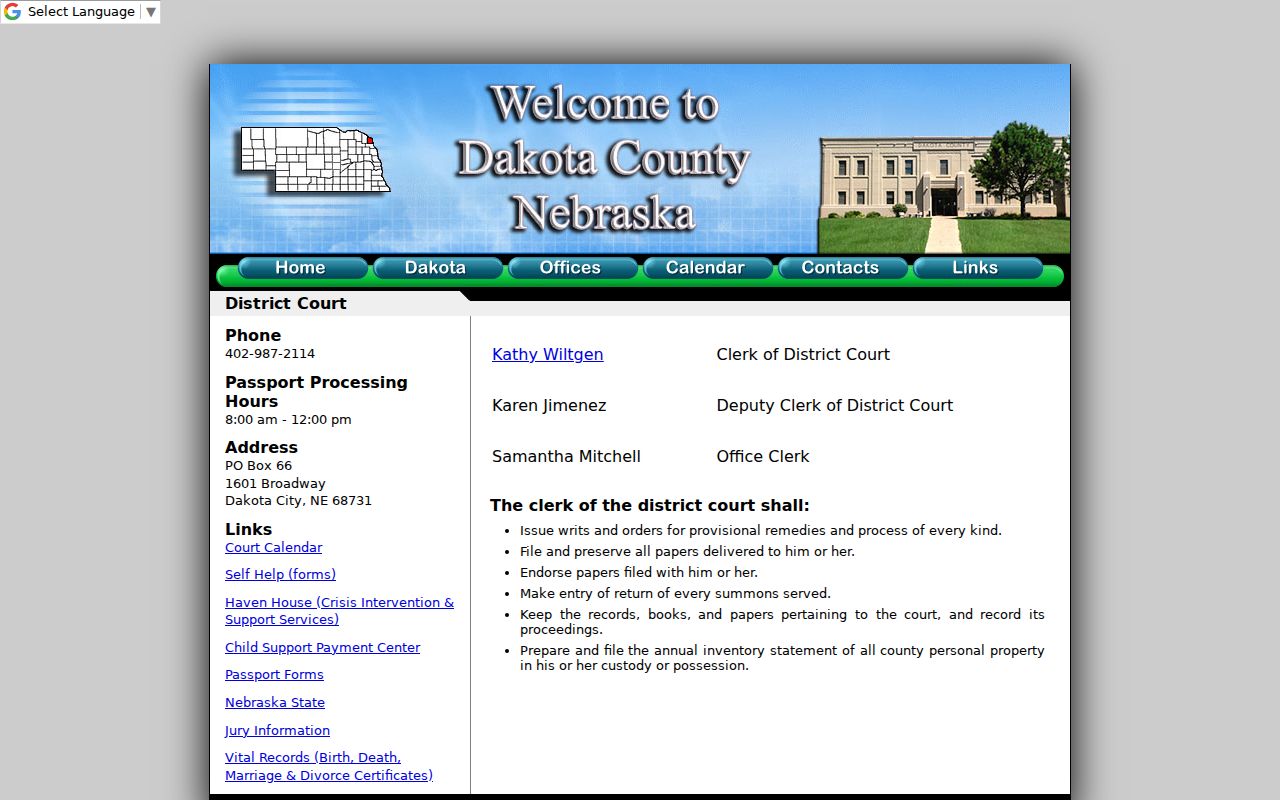
The clerk route matters. A plain docket view, a certified copy, a transcript, and a restricted appendix can each carry its own form, access rules, and cost.
Public Access to Civil Dockets
"Public" has limits here. A record category can be public without every document being viewable online or copied free. Nebraska Rule § 2-215 permits electronic inspection through a trial-court clerk's public terminal or the State Library, subject to restrictions. Unconverted paper sits outside that rule. The gap shows up fast. A docket index can be visible while an attachment, image, appendix, or transcript stays unavailable or behind a separate request process.
Key Rules:
Nebraska Supreme Court Rules §§ 1-803 to 1-806 - identify public court-information categories such as registers of actions, calendars, judgments, and available images.
Nebraska Supreme Court Rule § 2-215 - provides public electronic-view access while preserving restricted and paper-only boundaries.
Neb. Rev. Stat. § 84-712 - supplies the written-request, response, estimate, access, or denial framework for public records.
Not every request starts at the courthouse. For a policy or agency record rather than a specified case document, the Nebraska Public Records Act may be the right fallback. For court-file documents, start with the clerk keeping the case. The four-business-day statutory response framework is no promise that a large, complex, or restricted record arrives by that date.
Dakota Civil Docket Privacy Boundaries
Privacy rules shape Dakota County civil dockets. Nebraska Uniform County Court Rule § 6-1464 protects personal and financial information in civil court records. Birth dates, gender, Social Security numbers, and financial-account numbers should not appear in public civil filings. Confidential appendices can hold the protected details instead. Redaction is the parties' and counsel's job. The clerk need not review every filing. So a public docket is not permission to repeat personal data found in a record.
Spot sensitive information in a filing? Do not republish it. Ask the filing clerk whether a public redacted copy, a restricted appendix, or another access limitation applies. Probate, guardianship, conservatorship, protection-order, and domestic-relations material deserves extra care even when the case index is public.
For Dakota County civil records, Nebraska Rule § 6-1464 draws the personal-data line.
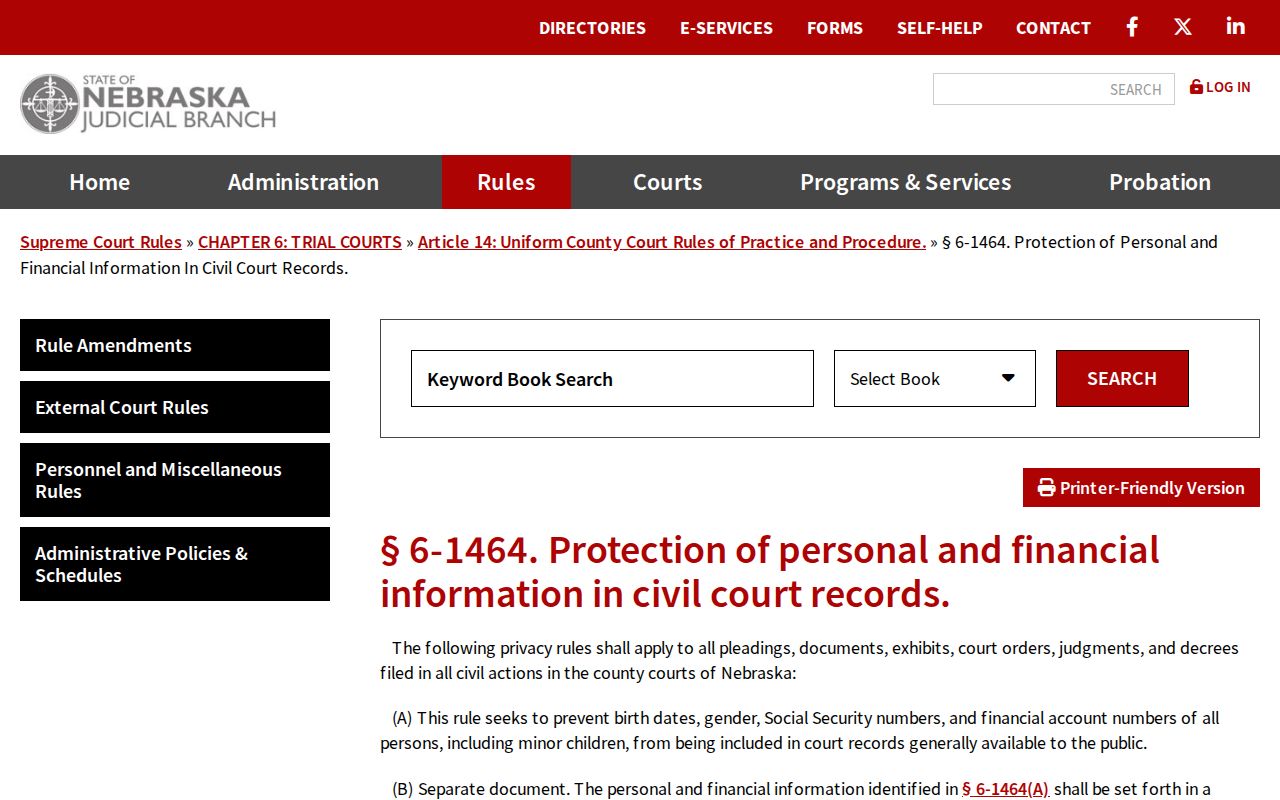
The rule points the other way, too. It favors a narrow request for just the public record you need, over a broad one that could sweep in protected personal or financial material.