
How to Get Court Records
Searching and copying are two different tasks in Nebraska. For the search side, the state's case-information services run trial-court lookups through JUSTICE. Contact the clerk who holds the file for everything else. That covers copies, certification, transcripts, restricted records, and local status. A one-time JUSTICE party-name search costs $17. It returns at most 30 results and stays open for three calendar days. That is enough to locate a Dakota County case. It does not hand over every document, though. It is no replacement for a clerk-issued copy.
Dakota County runs no separate county docket database and has no general court-record request mailbox. Route your request to the right clerk for the court level. County Court handles traffic tickets and misdemeanors. It also covers small claims, probate, county civil matters, municipal ordinances, and preliminary felony questions. The Clerk of District Court keeps district dockets. That office also holds felony files, district civil matters, and domestic-relations routing. Whether you mail it or call, a request works best when it names the case, the document, the date range, a delivery method, and whether you want a plain or certified copy.
- Find the case number if possible. If it is unknown, gather the full party name, approximate filing year, case type, and whether the matter was in County Court or District Court.
- Use JUSTICE for a paid statewide party or case search, or inspect eligible electronic records at a courthouse public terminal. The State Library is another public-view location under Nebraska's electronic-access rule.
- Call the appropriate Dakota County clerk before making a special request. Ask whether the item is public, imaged, paper-only, restricted, or subject to a form, estimate, deposit, identification, or notarization requirement.
- For a plain or certified copy, submit a focused written request by the channel the clerk confirms. Mail is documented; fax acceptance should be verified, and no general Dakota court-record email or drop box was found.
- Use a formal Nebraska Public Records Act request for an appropriate judicial-branch policy or agency-held record. A specified case-file copy ordinarily belongs with the clerk of the court where it was filed.
Note: A search that returns nothing is not a clerk-issued certificate that no Dakota County case exists.
Dakota County Court Record Search
JUSTICE is the statewide trial-court system. It covers Dakota County along with every other Nebraska trial court. A search there can pull up a case summary. It also returns a party index, a register of actions, financial fields, and links to any document images on file. Fresh entries can trail reality by about a day. A name match is not proof of identity either. Confirm the court level, case year, type, and case number before you ask the clerk for anything.
The images have a hard boundary too. Nonconfidential documents filed or uploaded after April 16, 2008 may carry images. Older files, paper-only files, unconverted records, and restricted documents may not. When the remote result comes up short, the courthouse terminal and the clerk are the next stop. The Nebraska public-view rule sets out terminal inspection at a clerk's trial-court office or the State Library.
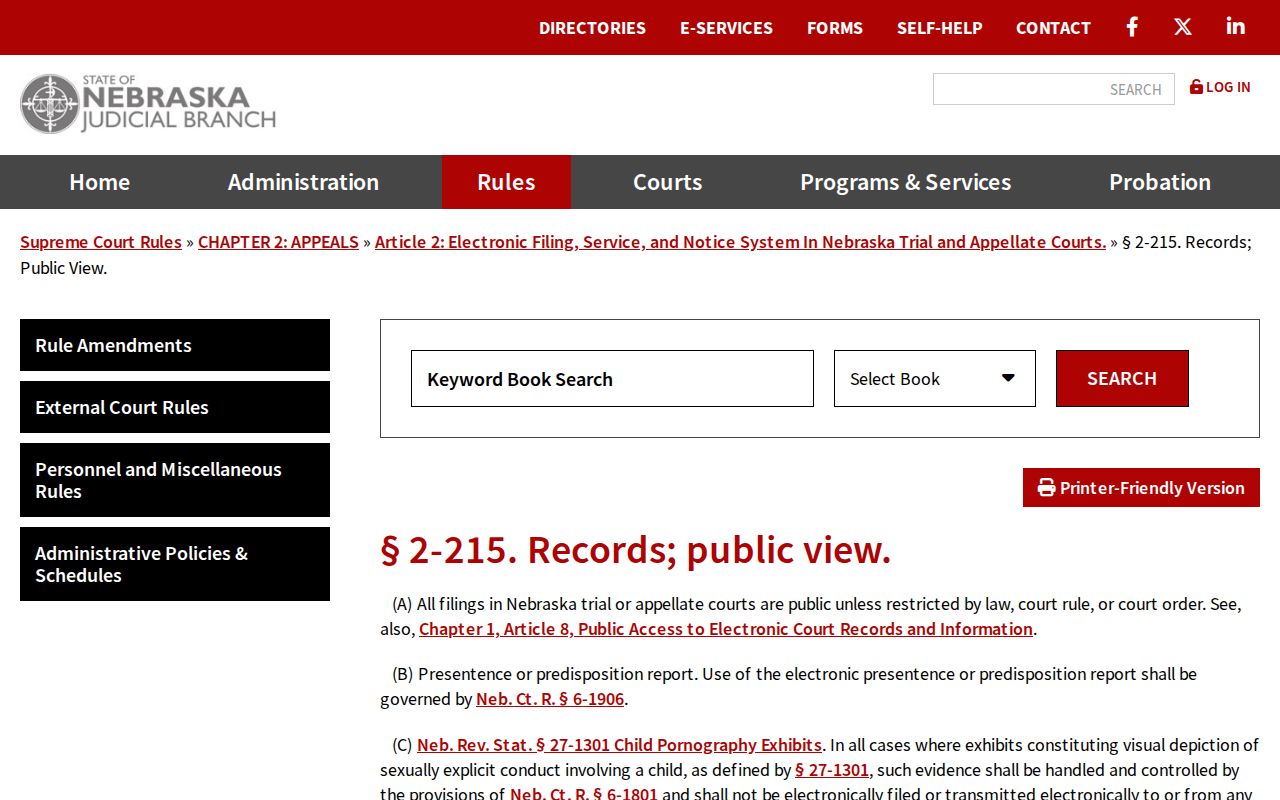
That route works well for checking an electronic court record. It does not override a seal. It cannot bend a confidentiality rule, and it cannot conjure a paper record that was never digitized.
Types of Court Records
A court record is not a single fixed document. Nebraska sorts public court information into layers. A Dakota County request goes smoothest when you name the layer you want. The register of actions is the running event log that most people call the docket. A case summary and a party index help you pin down the file. Orders, judgments, decrees, pleadings, images, and transcripts are separate products. So are audio recordings and certified copies. Each has its own access rules and fees.
- Case summary and party index for basic case identification
- Register of actions showing filings, hearings, and orders
- Filed pleadings, orders, judgments, and decrees when public
- Available electronic images of nonconfidential filings
- Plain or clerk-certified paper copies
- Typed county transcripts and, where available, county digital recordings
Dakota County Court Record Images
An image link is not a complete case file. JUSTICE can attach an available electronic image to an entry in the register of actions. The image may still be missing, though. It can be missing even when the case shows up fine. Restriction status, confidential attachments, a legacy paper file, conversion gaps, and plain data-entry timing can all explain the gap.
When you ask the clerk, name the exact document rather than asking whether a case is online. A request for an order dated on a certain day is far easier to fill. So is a request for a pleading by name. Both are easier than a request for everything. Remember that protected personal and financial data in any public copy still fall under Nebraska's access and redaction rules.
What a Court Record Contains
JUSTICE case details and a clerk file do not always carry the same amount of material. The categories below describe the usual public-facing fields without reproducing a private case caption, a personal address, financial detail, or juvenile information. What is available depends on the court, the case type, and any restriction in place.
| Case number | The court, county, type, year, and identifier used to distinguish one file from another. |
|---|---|
| Case summary | High-level court, party, judge, attorney, and status information when the system makes it available. |
| Register of actions | The chronological log of filed documents, hearings, orders, and other court events. |
| Orders and judgments | Formal court actions that may be public, redacted, restricted, or available only from the clerk. |
| Document image | An electronic copy link when a nonconfidential filed image is available, not a promise that every paper is online. |
A hearing record may be a typed transcript or an audio recording rather than a docket printout. A certified copy is its own distinct product: a clerk-authenticated copy backed by a certificate or seal. Naming the format up front keeps a plain image request from being mistaken for a formal court product.
Dakota County Transcript Requests
Want the spoken record of a Dakota County hearing? County Court handles typed transcripts through form CC 1:14. The form wants basics: county, case number or name, hearing date, time, and location. It also asks for the judge, whether you need the full or partial hearing, any exhibits, and a privacy acknowledgment. The clerk sends an estimate. Pay first, then the transcript gets prepared. And know what you are ordering. A transcript is not a free printout of the docket.
Digital recordings run differently. Appendix 6 covers available county recordings. It takes up to two hearing entries per request. The form also wants the judge, courtroom, date, time, and scope. One wrinkle: current county guidance and the Appendix 6 PDF state the audio fees differently. Check the amount, delivery method, and privacy limits with County Court before paying. District transcripts go through the district route, and a nonparty may need extra approval.
The Nebraska public court-record rules draw the line between public record categories and restricted material. Some court products need their own separate request.
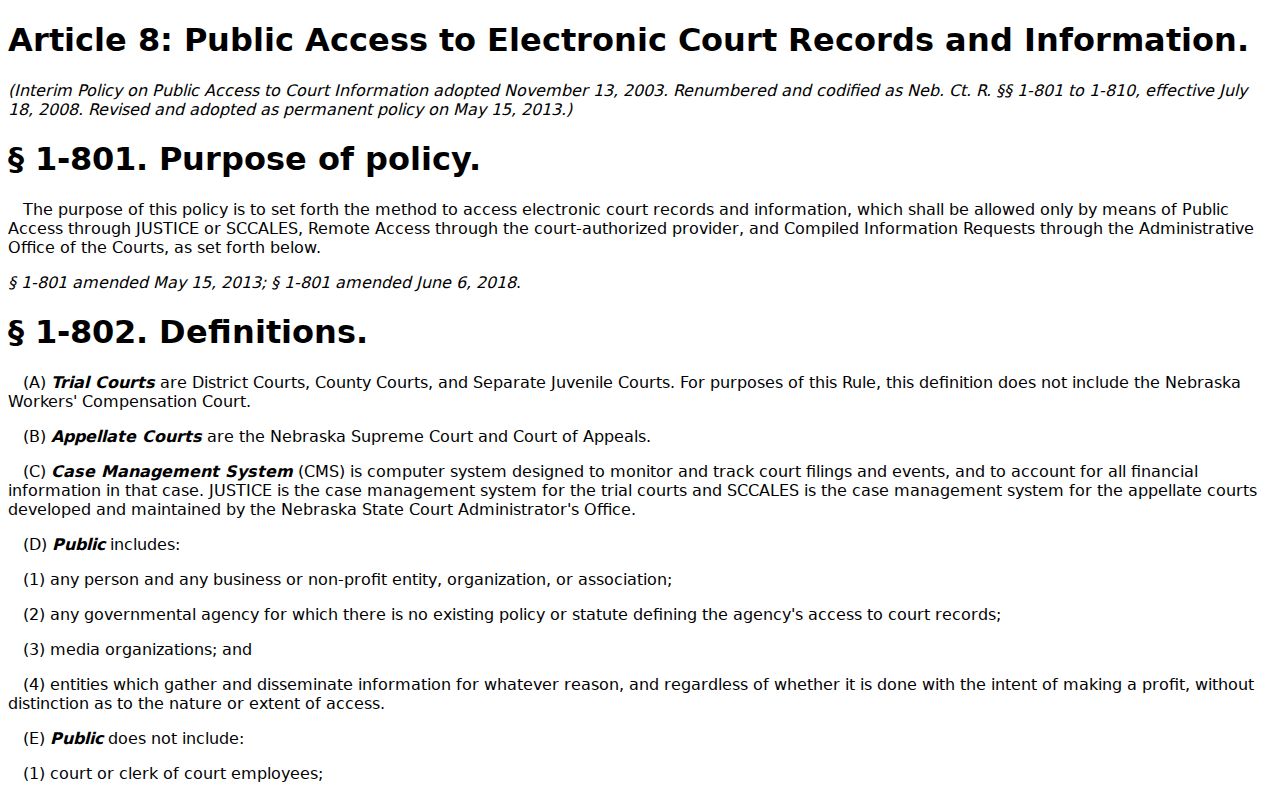
That line matters more than it looks. A requester who wants the words spoken at a hearing needs a transcript product, not the case's written docket entries and filed documents.
Certified Copies and Fees
Copies come in two flavors. A plain copy is just a reproduction of a public record. A certified copy carries the clerk's certificate or seal. For county court, state law sets the price. It is $0.25 per page plus $1 for a certificate or seal. Dakota District Court is another matter. Its local page says copies and transcripts are charged but posts no exact fee schedule. Ask for the amount and payment instructions before you send any money.
| Item | Amount | Use or limit |
|---|---|---|
| County Court plain copy | $0.25 per page | County-court schedule under Nebraska law; confirm page count and any mailing cost. |
| County Court certificate or seal | $1.00 | Added when a clerk-certified copy is requested. |
| JUSTICE one-time search | $17 | Paid party-name search; it is separate from a clerk copy request. |
| District Court copy or transcript | Confirm with clerk | No Dakota-specific price was found in the inspected official sources. |
Route your request to the right office. The local county page lists one district number, and the current state directory lists another. Confirm the active contact before any time-sensitive request or payment.
Clerk of District Court
P.O. Box 66
Dakota City, NE 68731
402-987-2114 local / 402-987-2115 state directory
Dakota County Sealed Record Requests
A sealed record is neither a failed docket search nor a routine public-copy request. Nebraska's DC 1:12 sealed-record form covers a lot of ground. It asks about the case and the requester. It also covers release to yourself or a named recipient, plus statutory authority. You state whether you want exact documents or the full file. Payment, delivery, identification, and notarization all get addressed too. File it with the clerk of the court where the case was filed. Then ask about cost, timing, and any deposit.
- Plain copy
- An ordinary reproduction of a public record, without a clerk certificate or seal.
- Certified copy
- A clerk-authenticated copy with a certificate or seal, requested separately from a plain copy.
- Restricted record
- A record or document limited by a seal, confidentiality rule, juvenile law, protected data rule, or other court authority.
Normally, the sealed-record requester is the person whose record was sealed, subject to court authority. A named recipient may need identification. Don't sign the form ahead of time when the instructions require a signature before a notary.
Public Access and Sealed Records
Nebraska opens a wide door to court records. Party indexes, case summaries, registers of actions, calendars, judgments, orders, decrees, and available images are all public, subject to court rules and confidentiality limits. But public does not always mean viewable from home. It does not guarantee instant indexing, free copies, or the complete file either. A courthouse terminal is one access channel. It still cannot defeat a seal or privacy restriction.
Juvenile files and sealed juvenile records carry stricter confidentiality. Civil files should not expose birth dates, gender, Social Security numbers, or financial-account numbers. If an image is missing, ask whether a redacted public version, a case index, or a particular public document can be released instead of assuming the system failed.
Key Rules:
Neb. Rev. Stat. § 84-712 establishes the public-record request and response framework, including access, estimates, denial explanations, and personal-equipment copying during business hours.
Nebraska Supreme Court Chapter 1, Article 8 identifies public court-information categories and limits unauthorized bulk access.
Rule § 2-215 permits public electronic inspection at a clerk-office terminal or the State Library while preserving restriction and paper-record limits.
Dakota County Public Record Requests
A written Nebraska Public Records Act request can do several things. It can seek access or a cost estimate. It can also request an alternate format or an explanation of a denial. Section 84-712 builds in a four-business-day response framework. Four days is not a promise, though. A large file, a transcript, a sealed request, or a paper-record search may take longer. The court can need research time, payment, a narrower scope, or a different form.
Formal judicial-branch requests follow court policy to the State Court Administrator. But for a known Dakota County case document, start with the filing court's clerk. Name the exact document and date when you can. Ask whether an electronic image exists and request an estimate. Keep the clerk's instructions and your payment receipt with the request.
The official Nebraska Public Records Act text sets the baseline for this formal request route.
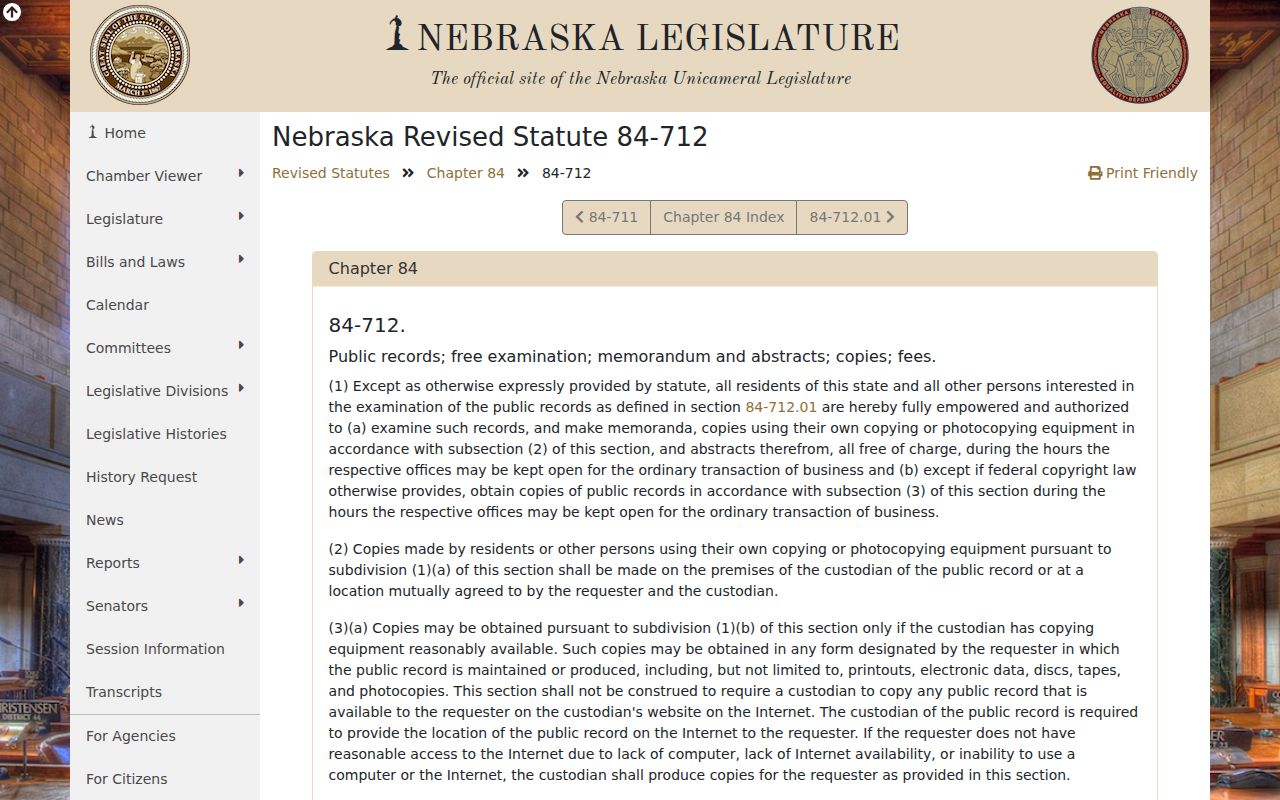
A narrow request beats a broad one. Asking for a specific document, with an early estimate, gives the clerk a clearer path than demanding an entire file. Note: send a court-file request to the court clerk. Don't default to the separate Dakota County Clerk, who handles county-government business instead.