
How to Search Criminal Dockets
For a Dakota County criminal docket search, most people start with the statewide tool Nebraska JUSTICE. It covers trial-court cases across Nebraska. Dakota County Court and District Court are included. A one-time party-name search costs $17, charged even if no cases come back. Results cap at 30 cases, and access to details you open lasts three calendar days. You will need to agree to the terms. You will also need a browser that runs the search controls.
Type the full legal name from the court notice when you can. Too many hits? Narrow by Dakota County, court level, case type, or year. The official search demo walks through those narrowing fields. A case number beats a common name. Captions may carry punctuation, abbreviations, or multiple parties. For copies or restricted-file questions, the clerk is still the local route. The clerk can also help you find the right court.
- Open JUSTICE, accept the terms, and choose a party-name or exact case-number search.
- Begin with the party name. Narrow to Dakota County only when the statewide result list needs it.
- Choose County Court or District Court when the notice or case prefix identifies the court level.
- Open the matching result and compare the caption, case number, register of actions, hearings, and disposition.
- Ask the filing court for a specific public document or certified copy when a screen result is not enough.
Note: a filing entered today may lag behind the statewide nightly update, which official JUSTICE materials put at roughly 24 hours.
Dakota Criminal Docket Case Numbers
The criminal type segment is CR. That label alone tells you nothing about the court. In the Nebraska pattern, C generally marks County Court and D District Court. Dakota County is generally the 22 county segment. So an illustrative case number looks like C-22-CR-26-0001234 or D-22-CR-26-0001234; punctuation and zero padding follow the number printed on the court notice.
- C prefix
- Usually a Dakota County Court record, where misdemeanors and felony preliminary proceedings are routed.
- D prefix
- Usually a Dakota District Court record, the route for felony trials and district-level criminal proceedings.
- CR segment
- The criminal case type in the official Nebraska case-number format.
A felony can generate more than one Dakota criminal docket worth checking. County Court often handles the preliminary proceeding. The felony case itself moves forward in District Court. Track the whole prosecution. Search both court-level paths instead of stopping at the first CR result you see.
What a Criminal Docket Shows
JUSTICE can display quite a bit when the fields are available. That includes a case summary, party index, case type, judge, attorney, offense information, financial fields, and the register of actions. That register is the procedural log of documents, hearings, orders, and other events. It is the Nebraska record closest to what most people picture as a court docket. A document-image link may appear for a nonconfidential filing. But an image is not guaranteed for every event. Older paper files may lack one entirely.
| Case number | The court, Dakota segment, criminal type, case year, and identifying number, such as D-22-CR-YY-ID. |
|---|---|
| Caption and parties | The court’s displayed case title and party roles. A name match should be checked against the case number. |
| Offense information | Charge data shown in the case detail. It is not a final finding by itself. |
| Register of actions | The running history of filings, settings, orders, and available document-image links. |
| Disposition | The recorded outcome or status. Read the judgment or order before drawing conclusions from a charge. |
The Nebraska Judicial Branch case-information service is clear on one point. The public trial-court search is court-record access, not a full criminal-history report. Missing fields, a thin index, or no image can simply reflect privacy rules, conversion limits, or a record not yet entered.
Missing Dakota Criminal Docket Results
A blank result does not prove a Dakota criminal docket is absent. Start with the basics. Check the spelling, the case year, and the CR type. Also check whether the notice points to County Court or District Court. Then give the nightly update time to run. Official JUSTICE troubleshooting also notes that a new case may need extra time for data entry. A recent filing may call for another search later. Or it may call the filing court.
Useful next step: If a case number is known, search that number before repeating a paid name search. If the index is visible but an image is absent, ask the clerk whether the document is restricted, sealed, paper-only, older than the electronic-image boundary, or not yet converted.
The Judicial Branch fee announcement documents the January 2026 shift. It moved the fee from the older $15 one-time rate to $17. Cached pages can still show the old price. The current landing page and payment flow govern any new transaction.
Nebraska’s January 2026 JUSTICE fee update lays out the current one-time and subscriber pricing. That pricing sits behind this criminal-docket search.
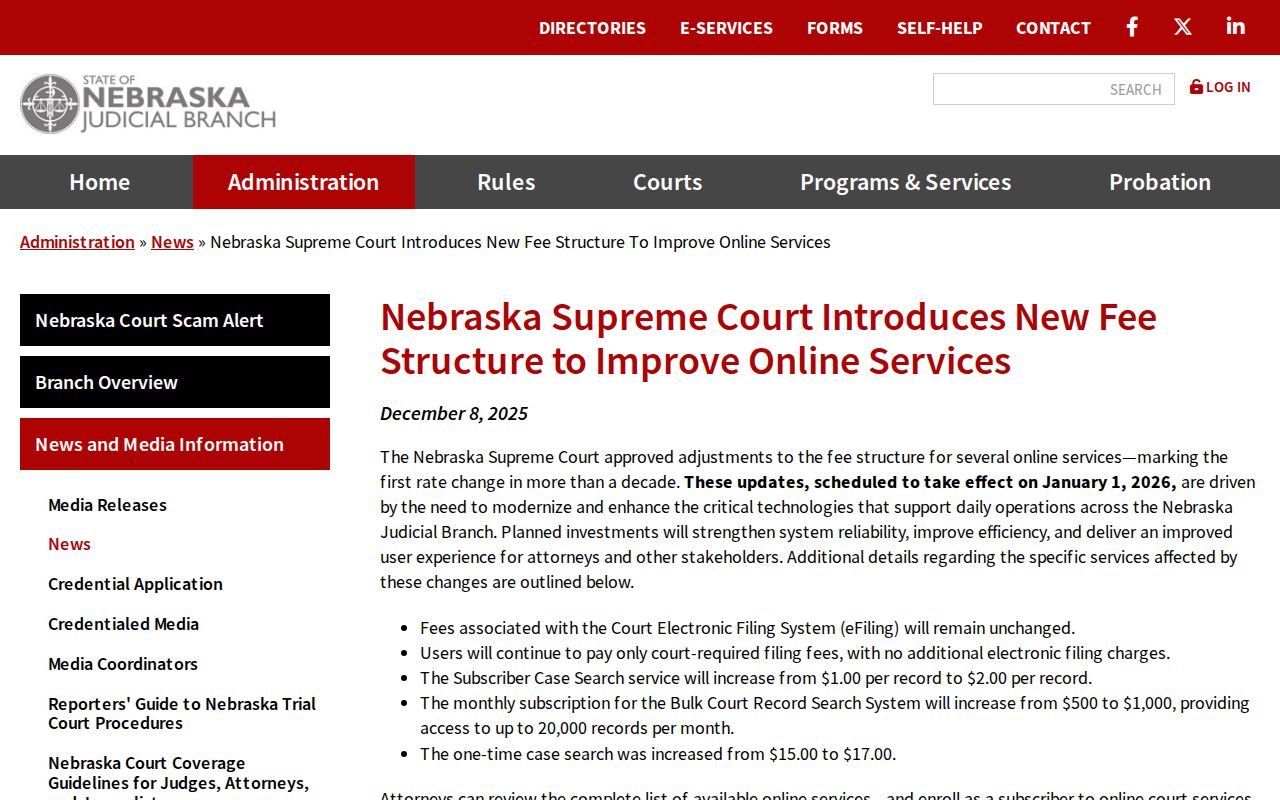
The announcement helps separate the current fee from outdated support pages. It does not remove the basic task of matching a Dakota result to the correct court and case number.
Stages on a Criminal Docket
Entries on a criminal docket can cover an arraignment, preliminary hearing, bond or release review, motion, pretrial or status setting, plea, trial, sentencing, or review. Treat these as stage words only. The wording on the actual Dakota criminal docket controls. A hearing date marks a scheduled event. A filing date records when a document was entered. Neither counts as the final outcome without the disposition and any judgment or order.
Docket flow: Charge Filed › Arraignment › Preliminary or Pretrial Setting › Plea or Trial › Disposition
A charge, complaint, or preliminary-hearing entry is not a conviction. The JUSTICE FAQ tells users to read the disposition and related court fields rather than turn a charge into a final result.
Dakota Criminal Docket Filing Context
Annual court reports explain why the court-level prefix matters in Dakota County. For FY2025, the county-court table shows 304 felony preliminary or related filings. It lists 895 misdemeanor filings. It also lists 1,193 traffic filings. The district-court report lists 11 matters under “Felony 1” and 164 under “Other Criminal.” These are filing counts, nothing more. They are not convictions, clearance rates, pending inventory, or outcomes for any named person.
Those categories come from the county-court annual report and the district-court annual report. They offer context on docket routing, never a substitute for the live case record.
Which Court Holds Criminal Dockets
Dakota County splits its criminal work between two clerks. Dakota County Court handles misdemeanors, traffic tickets, municipal-ordinance cases, and the preliminary side of felony prosecutions. Its clerk takes criminal docket questions at 402-987-2145. Felony trials move to Dakota District Court, the general-jurisdiction trial court for the county. Its phone listings disagree. The local district-clerk page shows 402-987-2114, while the state directory shows 402-987-2115. Confirm the current number before mailing a request.
One prosecution can span both files. A CR case with a C prefix may cover only the preliminary stage, while a D-prefixed district case holds the trial record. The statewide search returns both levels, but it never merges them into a single procedural history. When a case number is missing or unclear, the Dakota County judicial contacts page helps. It routes the question to the right office.
Get the details straight before requesting a copy. You need the case number, the document name or date, and whether you want a plain or certified version. County Court charges $0.25 per page plus $1 for a certificate or seal under Neb. Rev. Stat. § 33-126.05. Ask the Dakota District Court clerk to quote its copy fee before you send payment.
Dakota Criminal Docket Calendar Checks
The docket and the hearing calendar serve different jobs. Use JUSTICE for the case record and the Nebraska Multi-Court Case Calendar for a current or future Dakota setting. Select County Court or District Court, select Dakota, then search by date or by at least two characters of a last name. The calendar can show the case number, caption, date, time, and location.
An empty calendar result is not proof that no hearing exists. The official calendar warns that court type, county, search value, changed settings, restricted information, and update timing can affect results. Recheck close to the hearing, and contact the court when a notice and an online result conflict. The separate Dakota County court calendar page provides the broader settings-search workflow.
Public Access and Sealed Criminal Dockets
Nebraska rules presume a lot is public. Party indexes, case summaries, registers of actions, calendars, judgments, orders, and available images all sit open unless a restriction applies. But online access is not the only channel. A public terminal in the clerk's trial-court office often beats an incomplete remote search, and the clerk can say whether a specific public copy exists. Keep expectations modest, though. Public status promises no online image, immediate indexing, unrestricted copying, or no-record certificate.
Key Rules:
Nebraska Supreme Court Rules §§ 1-803 to 1-806 - identify public court-information categories and restrict unauthorized bulk access.
Nebraska Supreme Court Rule § 2-215 - permits public electronic inspection while recognizing restricted and paper-only records.
Neb. Rev. Stat. § 84-712 - supplies the written-request and public-record access baseline, including the response, estimate, or denial framework.
A public index can sit beside a sealed document. The image may be restricted too. Or the file is still paper that no one has converted. Ask which limit applies before assuming a glitch. A formal Public Records Act request fits policy or agency records, but a copy from a specific case belongs first with the clerk of the court that filed it.
Dakota Criminal Docket Access Limits
Juvenile matters in Dakota County run through County Court. They are not ordinary adult criminal docket results. Nebraska law restricts juvenile records. The official JUSTICE notice states that an adjudication under § 43-280 is not a conviction. A juvenile result carries no adult-criminal meaning. A general name search will not unlock protected juvenile details.
When an adult record has been sealed, the missing result is not an invitation to work around the seal. The seal still stands. The juvenile confidentiality statute and the juvenile sealing statute impose separate limits of their own. The court's sealed-record process names the eligible requester, the document scope, and the identification and delivery requirements.
The Nebraska juvenile-record confidentiality law sets the rules this Dakota County criminal-docket record rests on.
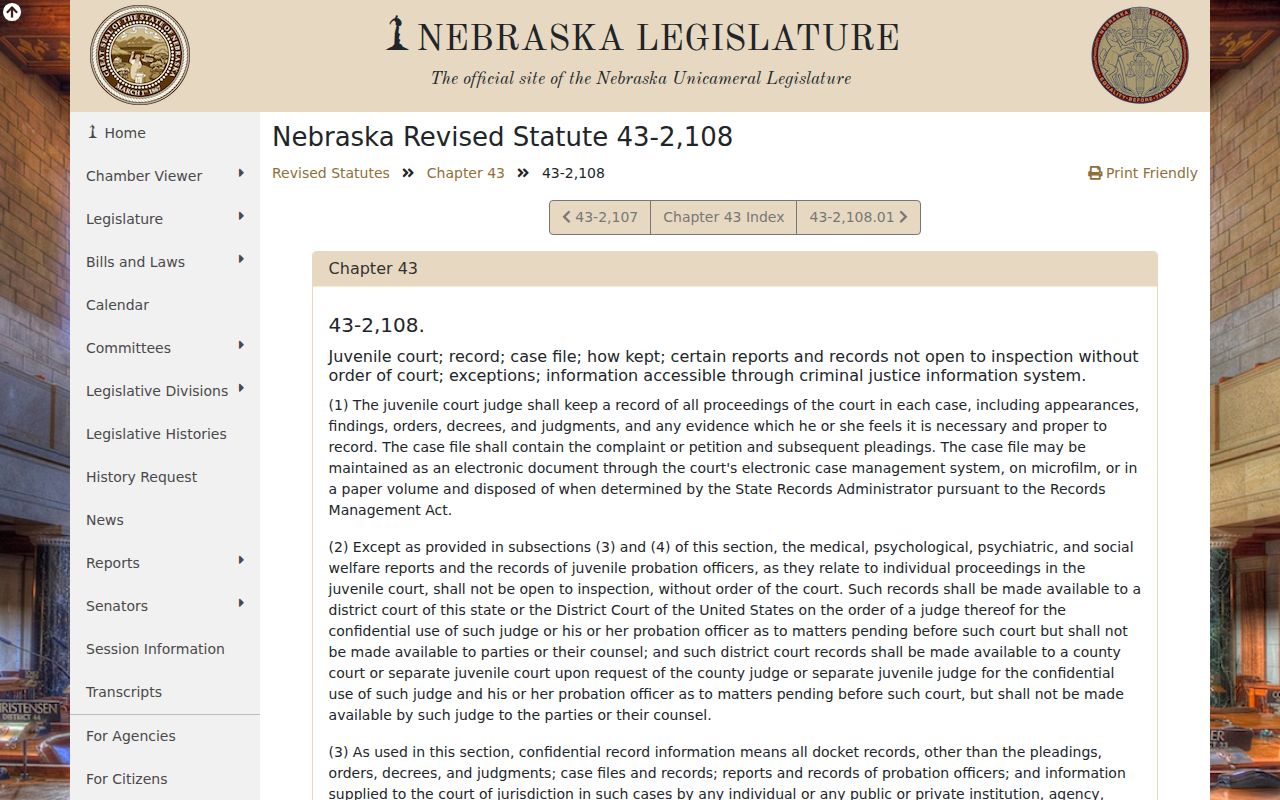
That statutory boundary has a practical effect. A Dakota criminal docket search still serves public adult court information well, while omitting juvenile and sealed material. The JUSTICE one-time search landing page sets out the terms gate, access limits, and notice that apply to public criminal-case searches. Read those terms before you begin.
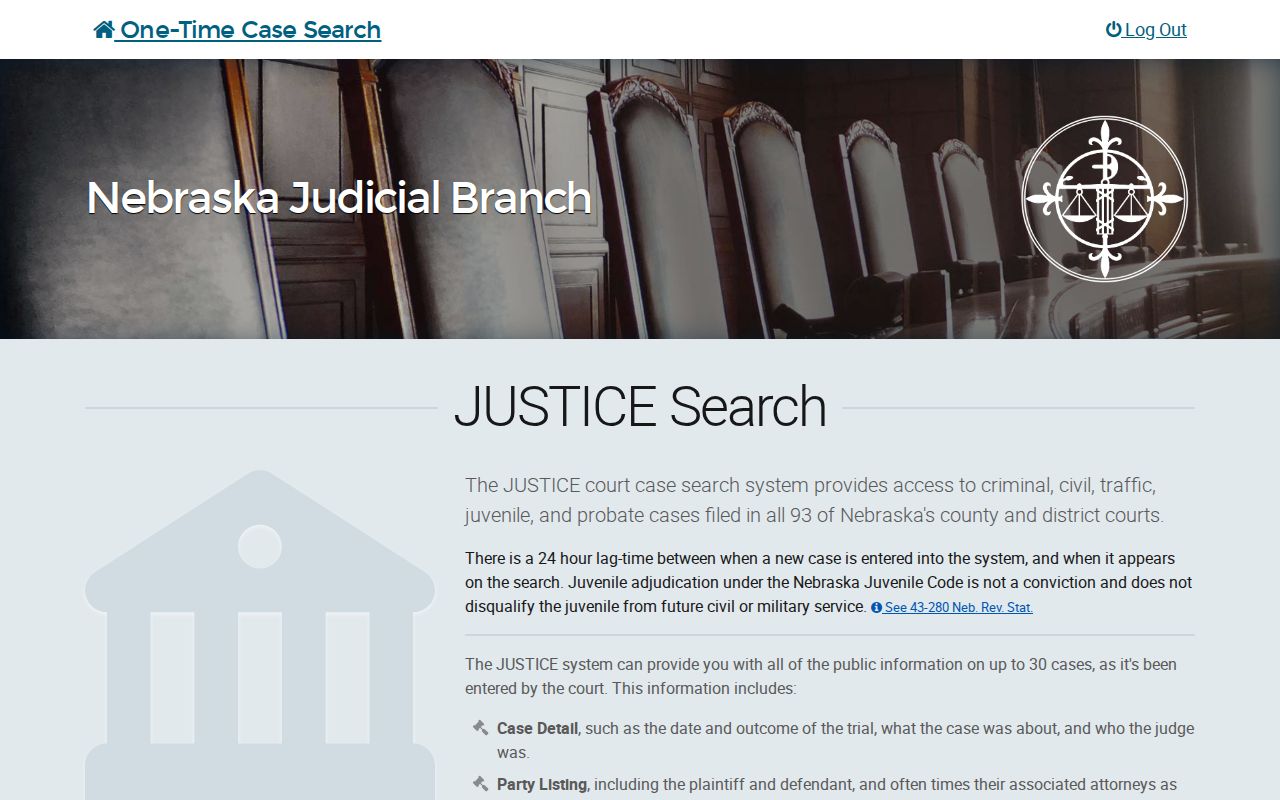
The terms page is blunt. JUSTICE is a court-record search tool with limits, not a complete view of every Dakota County criminal record.